


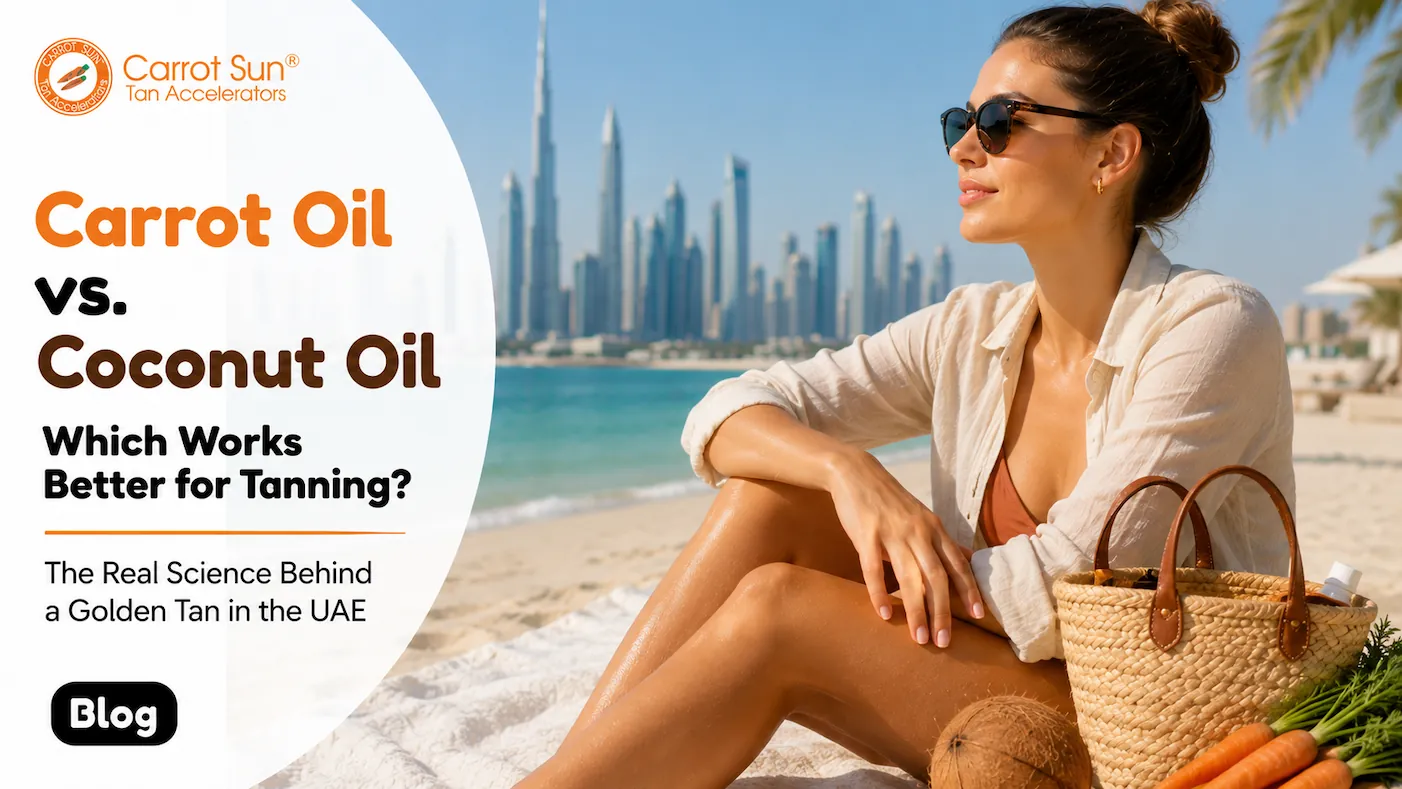
Carrot Oil vs. Coconut Oil: Which Works Better for Tanning?
Spending a weekend at JBR or Kite Beach? Then you have probably stared at your beach bag and wondered: should I use carrot oil or coconut oil for tanning today?
Both oils feel great on warm skin. However, they work in completely different ways. One simply sits on the surface and moisturizes. The other actively triggers your skin’s pigment production.
So if you want a deep, lasting bronze under the UAE sun, understanding the difference matters. Let us break it down clearly.
The Core Difference Between Carrot Oil and Coconut Oil
Carrot oil is a biological tanning accelerator. It uses plant pigments to stimulate melanin production inside the skin. Coconut oil, on the other hand, is a surface moisturizer only. It seals the skin barrier but does not trigger any color change. For faster, deeper bronzing, carrot oil is the active choice.
Raw coconut oil is made up of fatty acids. When you apply it to your skin, it sits on the top layer. It traps moisture and gives your skin a shiny look. However, it does not communicate with your skin cells at all.
Carrot oil works differently. It is an extract of carrot roots infused into a carrier oil. This extract is rich in active carotenoids. When your skin absorbs these compounds, they interact with your skin’s natural tanning pathways. As a result, your skin produces a faster and deeper color response when exposed to sunlight.
Carrot Sun bridges this gap by combining conditioning base oils with active botanical pigments. Their formulas deliver both surface hydration and genuine color acceleration in one product.
How Carrot Oil Accelerates a Deep Bronze
Carrot oil is rich in beta-carotene, a Vitamin A precursor and antioxidant. When UV rays hit your skin, beta-carotene signals melanocytes to speed up natural melanin production. The result is a deeper, golden-brown color rather than a painful, uneven burn.
When UV rays reach your skin, your body naturally produces melanin — the dark pigment that creates a tan. This process is called melanogenesis.
Carrot oil is ideal for this because it is packed with beta-carotene. Think of beta-carotene as high-quality fuel for your skin’s tanning cells. When you apply it before sun exposure, it gives your skin what it needs to darken more efficiently.
However, raw carrot oil from a health food store has limits. It lacks the cellular triggers needed to sustain rapid color development. This is where professional tan accelerators make a real difference.
Advanced formulas combine natural carrot extract with L-Tyrosine — an amino acid that directly triggers melanin production. Therefore, you achieve a darker shade in less time, with less sun exposure overall.
The Moisturizing Benefits and Hidden Risks of Coconut Oil
Coconut oil hydrates the skin well through its lauric and myristic fatty acids, which reduce water loss. But its high comedogenic rating (4 out of 5) means it clogs pores easily. In the UAE’s humid, sweaty conditions, raw coconut oil frequently causes heat rashes and body breakouts.
Coconut oil is a popular beauty ingredient for good reason. It is rich in lauric acid, which prevents transepidermal water loss (TEWL). When your skin stays hydrated during sun exposure, it is less likely to peel. This helps your tan last longer after the beach.
But there is a major problem with using raw coconut oil in the UAE.
Coconut oil scores a 4 out of 5 on the comedogenic scale. That means it is highly likely to clog your pores. On a hot, humid Dubai beach, heavy oil mixes with sweat and blocks your skin entirely. This traps bacteria and often causes painful heat rashes, clogged pores, and breakouts across the back and chest.
To get the moisturizing benefits without the pore-clogging risk, choose a lightweight, refined option like the coconut tanning spray. It delivers deep hydration in a breathable, non-greasy formula — much better suited for the Gulf climate.
Carrot Oil vs. Coconut Oil: Head-to-Head Comparison
Here is how raw oils compare to a professionally engineered tanning formula:
| Tanning Performance Metric | Raw Carrot Oil | Raw Coconut Oil | Carrot Sun Formulas |
| Melanin Activation Speed | Moderate (via beta-carotene) | None (surface only) | Maximum (with L-Tyrosine) |
| Pore-Clogging Risk in UAE | Moderate | Extremely High | Low (non-comedogenic) |
| Thermal Stability in Heat | Poor (oxidizes easily) | Poor (splits and greases) | Excellent (GCC-tested) |
| Color Longevity | Temporary surface tint | Short-lived | Long-lasting (with henna) |
Why Raw Oils Misbehave in the UAE Climate
The UAE’s extreme UV index and 40°C+ temperatures cause unrefined kitchen oils to oxidize and split on the skin. Instead of producing a smooth tan, these raw oils intensify heat on the skin’s surface. This leads to severe sunburns, blotchy spots, and long-term sun damage.
Sunbathing in the Gulf is not the same as sunbathing in Europe. Summer temperatures regularly exceed 40°C and the UV index reaches extreme levels. Your skin is under serious environmental stress.
Raw kitchen oils are not designed for these conditions. Without cosmetic stabilizers, coconut oil or crude carrot oil can split and oxidize under intense heat. Instead of helping your tan, they can amplify heat radiation directly on your skin. The result is often severe sunburn, patchy dark spots, and lasting skin damage.
So what is the safe approach? Many experienced tanners in the UAE follow a layered method:
- Start with sunscreen. Apply a broad-spectrum SPF 50 sunscreen about 20 minutes before going outside. This filters harmful UV radiation at the skin surface.
- Add your accelerator on top. Once the sunscreen absorbs, layer a thermally stable tan accelerator over it. This activates melanin safely and evenly without direct heat damage.
This two-step approach gives you color and protection at the same time.
Which Formula Matches Your Skin Type?
Fair or sun-sensitive skin should start with a coconut-based formula to build a gentle base tan. Olive, normal, or already-tanned skin can use a carrot-based accelerator to maximize melanin and lock in a rich, deep bronze.
Not all skin types respond to the sun in the same way. Therefore, your product choice should match your complexion.
Fair, Sensitive, or First-Time Tanners
If you burn easily or you are stepping into the sun for the first time this season, build your base gradually. Raw carrot oil can be too intense for lighter skin tones initially.
Instead, try the soothing coconut tanning cream. Its rich, hydrating base calms redness and allows you to develop a safe, even base tan without irritation.
Normal, Olive, or Pre-Tanned Skin
If your skin adapts quickly to sun exposure, you can go straight to maximizing your melanin production.
For these skin types, the carrot tanning cream is the top choice. It combines carotene extracts with natural henna to deepen your tan into a rich, multi-dimensional bronze that holds its color — even after long swims in the Gulf.
Final Verdict: Which Oil Should You Choose?
Both oils have their place in a smart sun care routine. However, they do very different jobs.
- Choose carrot oil when you want to break through a tanning plateau, activate deep melanin production, and achieve a dark, rich bronze quickly.
- Choose coconut oil when your skin needs moisture barrier repair, soothing after sun exposure, or gentle preparation for tanning.
For the best results, avoid raw kitchen oils entirely. They are not formulated for the UAE’s extreme heat. Instead, use a professionally engineered product that gives you active color acceleration and lightweight hydration in one stable formula.
Ready to find your perfect match? Browse the full range of Carrot Sun tanning products and choose the formula made for your skin tone and the Gulf climate.
Frequently Asked Questions
Does carrot oil or coconut oil give you a darker tan?
Carrot oil gives a significantly darker tan. Its natural beta-carotene content actively stimulates melanin production inside the skin. Coconut oil, however, acts as a surface moisturizer only. It makes the skin soft and shiny but does not increase your actual skin pigmentation.
Can I safely use raw coconut oil for tanning in Dubai?
No. Raw coconut oil lacks thermal stabilizers and can trap intense heat on the skin’s surface in Dubai’s climate. This significantly raises your risk of sunburn and peeling. Additionally, its heavy, comedogenic texture easily clogs pores and traps bacteria when mixed with sweat.
Does carrot oil provide natural sun protection?
Pure carrot oil offers only a negligible natural SPF of around 1 to 2. This is not enough to protect against UAE-level UV radiation. Always apply a dedicated broad-spectrum SPF 50 sunscreen before applying any tanning accelerator.
How do natural henna extracts extend a tan?
Natural henna extracts bind gently with proteins in the skin’s surface layer during sun exposure. This creates a warm, long-lasting golden tone. As a result, your color stays even and does not fade prematurely after swimming in salt water or showering.
What is the best way to stop a tan from peeling?
Restore your skin’s moisture barrier immediately after sun exposure. Applying a soothing formula like the Carrot Sun aftersun gel cream deeply rehydrates the skin, locks in your color, and keeps skin smooth and soft.
About author

Add comment