


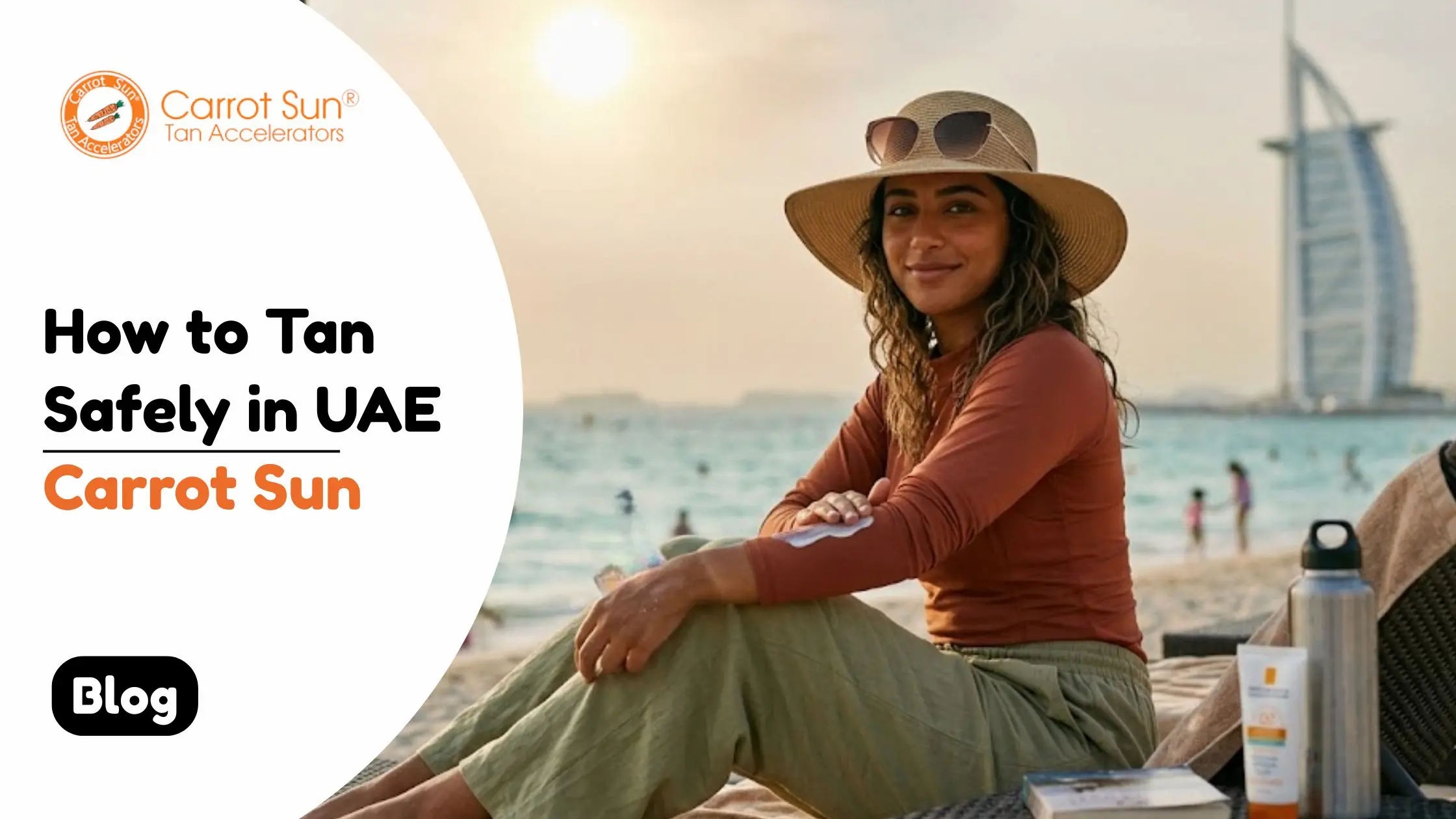
How to Tan Safely in UAE: Carrot Sun Expert Guide
Picture this. It’s a Friday morning in Dubai. You’ve got a beach bag packed, a spot booked at your favourite stretch of sand, and the kind of golden sunshine that most people in the world only dream about. All you want is that perfect, warm bronze glow.
But here’s what most people don’t realise until it’s too late — tanning in the UAE is a completely different game from tanning on a beach in Spain or Greece. The sun here doesn’t play by the same rules. And if you treat it like it does, you’re going to end up burnt, peeling, and back to square one within a week.
At Carrot Sun, we’ve spent years helping people across the Emirates achieve beautiful, lasting tans without damaging their skin. This guide brings all of that knowledge together in one place — practical, honest, and built specifically for the UAE climate.
Why Tanning in the UAE Demands a Smarter Approach
The UAE sits in one of the highest UV intensity zones on the planet. During summer months, the UV index regularly hits 11 to 13 — that’s classified as “extreme” by the World Health Organisation. For context, a UV index of 6 is already considered high enough to cause skin damage within 30 minutes of unprotected exposure.
What that means practically: what might take you 45 minutes to tan in the South of France could happen in 15 minutes here. And what might be a light pink tingle in Europe can become a second-degree burn on a Dubai beach if you’re not careful.
There’s another layer to this too. The UAE’s desert climate is incredibly dehydrating. The moment you step outside, dry air begins pulling moisture from your skin. Sun exposure compounds this dramatically, leaving skin tight, flaky, and prone to peeling — which is the fastest way to lose a tan you’ve worked hard for.
The good news? With the right routine, the UAE’s sunshine is genuinely one of the best places in the world to build a deep, rich, lasting tan. You just need a plan.
The Best Time to Tan in UAE
Timing is everything when it comes to safe tanning in the UAE. This is the single most common mistake we see — people arriving at the beach at noon and wondering why they’re lobster red by 2pm.
The two safe tanning windows are:
- Morning: 8:30am – 10:30am
- Late afternoon: 4:00pm – 6:00pm
During these windows, the sun is lower in the sky, UV intensity is significantly reduced, and you can actually enjoy being outside rather than fighting the heat. You’ll still get a beautiful tan — it just develops gradually and evenly rather than aggressively.
Avoid direct tanning between 11am and 3pm. This is when the UV index peaks. Even with sunscreen, extended exposure during these hours increases your risk of burns, hyperpigmentation, and long-term skin damage. If you’re poolside during midday, stay in the shade and reapply your SPF every two hours.
A tip from residents who’ve figured this out: shorter, consistent sessions across the week produce a far more even and lasting tan than one long marathon beach day. Think of it like strength training — progressive, not sudden.
Seasonal note: The UAE’s winter months (October through March) offer ideal tanning conditions, with temperatures between 22°C and 30°C and a gentler UV index. If you’re new to tanning in the UAE, starting during this period gives you more forgiving conditions to build your base.
How to Prepare Your Skin Before You Tan
Most people skip this step entirely. That’s a shame, because skin preparation is honestly the difference between a patchy, fading tan and one that looks even and lasts for weeks.
Think of your skin like a canvas. If the surface is uneven — rough patches, dead skin buildup, dry areas — the colour settles inconsistently. You’ll notice it most on elbows, knees, ankles, and the backs of legs.
Two days before your tanning session:
- Exfoliate thoroughly using a gentle body scrub or an exfoliating mitt. Focus on rough areas. This removes the layer of dead cells that would otherwise give you a patchy result.
- Moisturise generously. Well-hydrated skin tans more evenly and holds colour longer. Use a rich, nourishing body lotion — or better yet, a carrot-based moisturising oil that preps your skin and feeds it the vitamins it needs.
- Stay hydrated from the inside. Drink plenty of water in the 24 hours before a tanning session. Dehydrated skin doesn’t tan well — it burns instead.
On the morning of:
- Start with a lukewarm shower. Hot water strips natural oils.
- Pat skin dry rather than rubbing — you want it clean and dry but not stripped.
- Don’t apply heavy creams or lotions right before tanning — they can create an uneven barrier.
The Right Way to Layer SPF and Tanning Oil
This is the section most people need to read twice, because it’s the step that most commonly goes wrong.
Here’s the honest truth: tanning oil and sunscreen are not the same thing, and one cannot replace the other. Carrot Sun tanning oils contain zero SPF by design. They are formulated to be layered on top of your sunscreen — not instead of it.
Using tanning oil without sunscreen in UAE’s climate is genuinely risky. You’re essentially using a UV amplifier with no filter. Burns, premature ageing, and hyperpigmentation are the results — not a golden glow.
The correct layering order:
- Apply a broad-spectrum SPF 30 or SPF 50 sunscreen to all exposed skin
- Wait 15 to 20 minutes for the sunscreen to fully absorb and bind to your skin
- Apply your Carrot Sun tanning oil on top in slow, circular motions
- Reapply sunscreen every two hours or immediately after swimming
- Reapply tanning oil after each swim too — water washes it off
Why the wait? If you apply oil immediately over wet sunscreen, the oil acts as a solvent and breaks down the sunscreen film. You end up with gaps in your protection — hot spots where UV rays penetrate fully. The 15-minute wait is non-negotiable.
SPF vs Tanning Oil vs the Carrot Sun
| No SPF, oil only | SPF only | Carrot Sun | |
|---|---|---|---|
| Burn risk | Very high | Low | Low |
| Tan speed | Fast but patchy | Slow | Fast and even |
| Skin hydration | Poor | Moderate | Excellent |
| Tan longevity | Short — peels | Moderate | Long-lasting |
| Recommended in UAE | Not safe | safe | Best choice |
The Carrot Sun SPF 50 Sunscreen and Carrot Sun SPF 30 are designed specifically to work with Carrot Sun tanning oils — same brand, same formulation philosophy, perfect compatibility. Using them together means you’re getting full UV protection and maximum tanning acceleration at the same time.
Your Step-by-Step Safe Tanning Routine for UAE
Once you’ve prepped your skin and understood the layering rules, the actual routine is simple. Here it is in full:
The night before:
- Exfoliate and moisturise
- Drink 1.5–2 litres of water
On the day:
- Arrive at the beach or pool before 10am (or after 4pm)
- Apply SPF 30 or SPF 50 to all exposed skin — face, neck, ears, tops of feet
- Wait 15–20 minutes
- Apply Carrot Sun Oil in upward circular motions, 2–3 pumps per body section
- Start with 20–25 minutes of sun exposure for your first session
- Flip every 15–20 minutes for even coverage — set a phone timer
- Drink water consistently throughout
- After swimming: towel dry, reapply SPF, reapply tanning oil
- Reapply SPF every two hours regardless of whether you’ve swum
After tanning:
- Wait at least 4 hours before showering
- Use lukewarm water — not hot (hot water strips your fresh tan)
- Apply a nourishing after-sun lotion or carrot-based moisturiser immediately after drying off
- Avoid exfoliating for at least 48–72 hours
That’s it. Follow this routine consistently across 3–4 sessions per week and you’ll build a deep, even tan that actually lasts.
For a more detailed application breakdown, see our guide on how to use tanning oil step-by-step.
How to Make Your Tan Last Longer in UAE’s Climate
Getting a tan is one thing. Keeping it is another — and this is where most people fall short.
The UAE’s combination of intense sun, air conditioning, saltwater, and chlorine creates a brutal environment for tan retention. Here’s how to fight back:
Moisturise every single day. Dry skin sheds faster, which means your tan fades faster. Apply a rich body lotion or tanning oil daily — even on days you’re not sunbathing. Carrot-based oils are particularly good here because the beta-carotene continues to support your skin tone even without UV exposure.
Avoid long, hot showers. Hot water is one of the biggest tan killers. It opens pores and lifts the pigmented skin cells you’ve worked to build. Lukewarm and brief is the rule.
Stay out of chlorinated pools as much as possible immediately after tanning. Chlorine is essentially bleach — it actively breaks down the melanin in your skin. If you are swimming, rinse off and moisturise immediately afterwards.
Don’t exfoliate for the first 48–72 hours after a tanning session. Give the melanin time to settle and deepen before you do any scrubbing.
Eat foods rich in beta-carotene — carrots (obviously), sweet potatoes, mangoes, and papaya. These contain the same compounds that make Carrot Sun Oil so effective — they support your skin’s melanin production from the inside out.
With good aftercare, a tan built using Carrot Sun Oil in the UAE typically lasts 7 to 10 days. With consistent reapplication across multiple beach days, you can maintain a deep bronze for weeks.
Safe Tanning Tips by Skin Type
Not all skin tans the same way — and in UAE’s intense UV environment, understanding your skin type could save you from a painful mistake.
Fair or pale skin (Fitzpatrick Type I–II) Your skin burns before it tans. In the UAE, this means you need the highest SPF (50+), the shortest initial sessions (10–15 minutes only), and the gentlest tanning accelerator. The Carrot Sun Coconut Tanning Cream was specifically formulated for sensitive and fair skin — it builds a gradual base without irritation. Never skip SPF, ever.
Medium or olive skin (Fitzpatrick Type III–IV) You tan relatively easily but can still burn in UAE’s extreme UV. SPF 30 is a minimum, and sessions of 30–45 minutes in the safe windows are appropriate. The Original Carrot Sun Cream works beautifully on medium skin tones, producing a rich golden colour with henna helping the result last longer.
Darker skin (Fitzpatrick Type V–VI) You have more natural protection but you are absolutely not immune to sun damage in the UAE. UV rays cause cumulative harm regardless of skin tone. SPF 30 is still essential. The Carrot Sun Gold Oil is the strongest performer here, delivering a deep bronze with exceptional longevity.
Common Tanning Mistakes to Avoid in UAE
Let’s be direct about the things that most commonly go wrong:
- Tanning at midday. The most common mistake. UV is at its most aggressive between 11am–3pm. You will burn, not tan.
- Using tanning oil without SPF. In UAE’s UV index, this is genuinely dangerous. See the layering section above.
- Staying in one position. Flip every 15–20 minutes. One side cooked, one side pale is not the goal.
- Tanning with wet skin. Water droplets act as tiny lenses, magnifying UV intensity. They also wash off your product. Towel dry before applying anything.
- Showering immediately after. Wait at least 4 hours. Your melanin needs time to settle.
- Over-exfoliating between sessions. Gentle, infrequent exfoliation maintains your tan — aggressive scrubbing destroys it.
- Skipping hydration. Dehydrated skin peels. Peeling means losing your tan. Drink water, moisturise, repeat.
For a deeper look at tan maintenance and what to do if your tan goes wrong, see our guide on how to get rid of a tan in UAE and how to remove sun tan from face fast.
Ready for Your Best UAE Tan Yet?
Tanning safely in the UAE isn’t complicated — but it does require a slightly different mindset than what most people are used to. Respect the UV, prepare your skin, layer your products correctly, and take care of your glow afterwards.
When you approach it this way, the UAE’s year-round sunshine isn’t a risk — it’s one of the best natural tanning environments in the world.
The Carrot Sun range was built specifically for this climate. From the SPF 30 and SPF 50 sunscreens that form your protective base, to the tanning oils and creams formulated with L-Tyrosine and beta-carotene to accelerate your melanin naturally — every product in the line exists because this sun demands something better than a generic holiday oil.
Want to know exactly where to use these products for maximum results? Read our guide on the best tanning spots in UAE — from Kite Beach to quieter local stretches that residents keep to themselves.
Frequently Asked Questions
What SPF should I use when tanning in the UAE?
Use a minimum of SPF 30 for most skin types, and SPF 50 if you’re fair-skinned, new to tanning in UAE, or planning a longer session. A broad-spectrum formula protects against both UVA (tanning rays) and UVB (burning rays). Apply it 15–20 minutes before sun exposure and reapply every two hours. High SPF slows burning but still allows gradual, healthy melanin production — so you’ll still tan, just more safely.
Can I use tanning oil without sunscreen in Dubai?
No — and in the UAE this is especially important. Tanning oils amplify UV absorption to speed up melanin production, which is exactly what makes them effective. Without an SPF base layer underneath, that amplification has no filter. Dubai’s UV index regularly exceeds 11 in summer, meaning unprotected skin can burn in under 15 minutes. Always apply sunscreen first, wait 15 minutes, then layer your tanning oil on top.
How long does it take to get a tan in UAE?
Most people see visible colour after just 20–40 minutes of safe-window tanning (before 11am or after 4pm). Results vary by skin type — fair skin takes longer to develop colour while olive and medium skin tones may notice a difference after a single session. The key is building gradually across multiple sessions rather than trying to get a full tan in one day, which typically results in burns rather than bronze.
What is the safest time of day to tan in Dubai?
The two safest windows are 8:30–10:30am and 4:00–6:00pm. During these periods, the sun angle means UV intensity is significantly lower than at midday, reducing burn risk while still delivering enough UV to stimulate melanin production. During winter months (October–March) the window extends slightly as the sun is gentler overall. Never tan between 11am and 3pm — this is when the UAE’s UV index peaks at its most dangerous levels.
How do I stop my tan from peeling in the UAE heat?
Peeling happens when skin is dehydrated or overexposed. To prevent it: moisturise daily with a nourishing oil or lotion, avoid hot showers after tanning, skip exfoliation for at least 72 hours after each session, drink plenty of water, and limit chlorine exposure. Carrot Sun’s tanning creams are especially helpful here — their rich emollient base keeps skin deeply hydrated during and after sun exposure, which significantly reduces peeling and keeps colour locked in longer.
Read next: How to Use Carrot Oil for Tanning in UAE
About author

Add comment